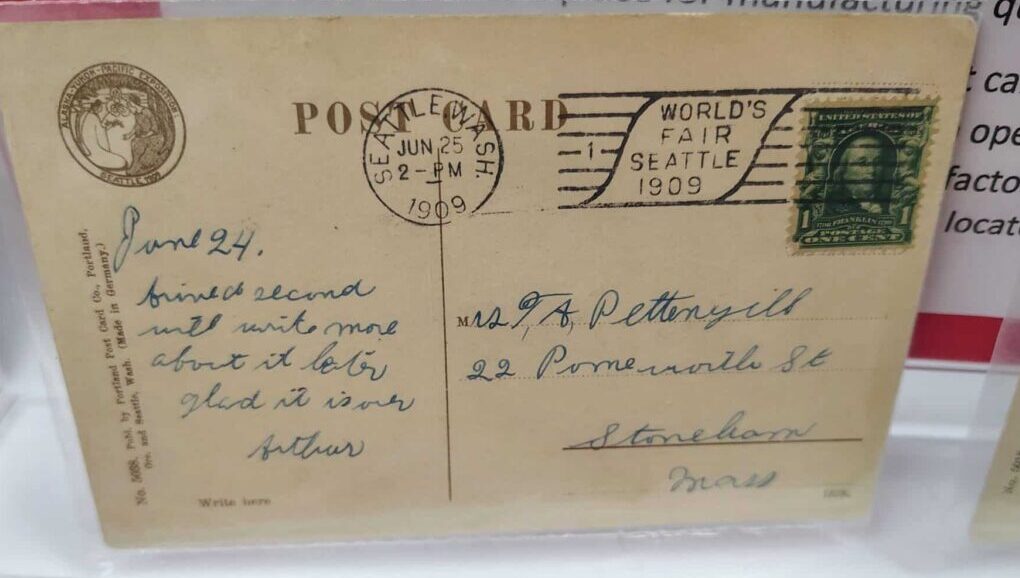
On June 24th, 1909, T. Arthur Pettengill wrote a postcard to his wife Edith, home in Stoneham from Seattle, Washington. It reads simply “Finished second. Will write more about it later. Glad it is over.”
He was exhausted from a grueling 24-day endurance contest during the international road race from New York to Seattle – then hosting a world’s fair. It was a brutal slog featuring everything from fording streams and struggling through a snowy mountain pass in the Cascades to facing down armed men determined to keep them from crossing a railroad bridge. And there was mud, lots and lots of mud. It rained most of the way from Ohio through Wyoming and the cars constantly bogged down on muddy dirt roads.
This was an era when gasoline was often ladled out of a random barrel in the back of a store, and turning on the headlights involved stopping and putting a match to acetylene gas in order to light a open flame.
The team were driving a 1908 Shawmut runabout – one of the few cars remaining after their Stoneham factory was burned to the ground on November 13th 1908. Entering the race was a last-ditch effort to get publicity and raise funds to rebuild the factory. But while team Shawmut entered Seattle second, they had actually won the race – due to a number of race violations that meant race organizers stripped a Ford Model T of the victory and declared the Shawmut the victor. Unfortunately, this was almost 5 months after the race ended and in the mean time, Henry Ford and the Ford Motor company had reaped a fortune in publicity.
Author Eric Moskowitz will be speaking about his book on the race at the society September 10, at 7:15 pm. You can also learn more about what happened to Pettengill and his fellow driver/mechanics Earle Chapin and Robert Messer in our new exhibit on Shawmut and the 1909 race.